
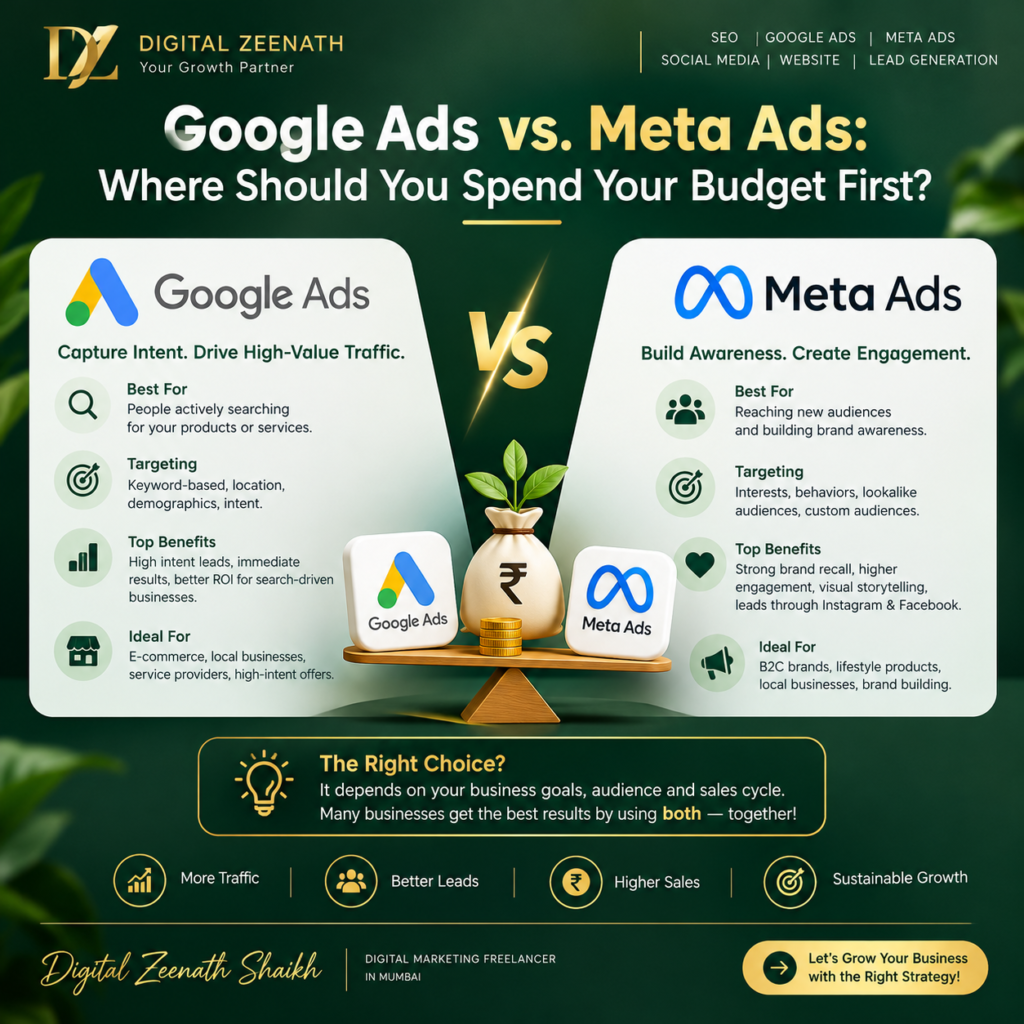
Google Ads vs. Meta Ads: Where Should You Spend Your Budget First?
By Zeenath Shaikh
Search Intent Google AdsHigh-Intent Leads Meta Ads Audience Targeting Retargeting ROAS CPC Cost Per LeadGoogle AdsThey ask. You answer.Meta AdsThey scroll. You spark interest.The core difference: Google captures existing demand, Meta creates it.
If you run a small or growing business, you’ve probably asked this at least once: “I only have budget for one platform right now. Which one should it be?”
The honest answer is that it depends on how your customers buy. Below is a practical way to decide, without the jargon.
The key difference: intent vs. interruption
Google Ads shows your business to people actively typing a need into the search bar, such as “emergency plumber near me” or “best CRM for small teams.” They already want something, so clicks tend to be closer to a purchase.
Meta Ads (Facebook and Instagram) place your offer in front of people who are scrolling, based on interests, behavior and demographics. They weren’t looking for you, so your creative has to earn attention first.
Google Ads works best when…
- People already search for what you sell
- You offer urgent or high-consideration services
- You want leads or calls quickly
- You serve a specific local area
Meta Ads works best when…
- Your product is visual or impulse-friendly
- Few people know the category exists yet
- You want to build awareness and a following
- You plan to retarget website visitors
Side-by-side comparison
| Factor | Google Ads | Meta Ads |
|---|---|---|
| Customer mindset | Searching, ready to act | Browsing, open to discovery |
| Typical cost per click | Often higher | Often lower |
| Lead quality | Usually higher intent | Varies, needs nurturing |
| Creative effort | Mostly text and keywords | Heavy on images and video |
| Speed to first leads | Days to a few weeks | Days, but more testing needed |
| Best for | Services, B2B, local, urgent needs | Retail, D2C, events, awareness |
Costs differ widely by industry, city and competition, so treat any benchmark as a starting point and track your own numbers.
So where should you spend first?
Do people search for what you sell?YesNot reallyStart with Google AdsAdd Meta retargeting laterStart with Meta AdsAdd Google search laterUnsure? Split the test budget and let the data decide.A simple decision path for your first ad budget.
A realistic starting split
If you can fund both, avoid spreading money thin. A common approach is to put most of your test budget where buyer intent is strongest, then keep a smaller share for the other channel.Service / local businessGoogle 70%Meta 30%Product / D2C brandGoogle 30%Meta 70%Illustrative starting points, not fixed rules. Adjust after 4 to 8 weeks of data.
Common mistakes to avoid
- Judging too early. Give each campaign enough time and spend to gather data, usually several weeks.
- Sending traffic to a weak page. Great ads can’t fix a slow or confusing landing page.
- Tracking clicks instead of leads. Set up conversion tracking before spending anything.
- Expecting Meta to behave like Google. Discovery traffic needs strong creative and follow-up.
- Skipping retargeting. Most visitors don’t convert on the first visit.
The bottom line
Choose Google Ads first if customers are already searching for you. Choose Meta Ads first if you need to introduce your product and build demand. For most businesses, the strongest long-term setup uses both: Google to capture ready buyers, Meta to nurture and retarget everyone else.
Not sure which fits your business?
Book a free ad account audit and get a clear, honest recommendation on where your first rupee should go.
Contact Zeenath Shaikh to get started.