
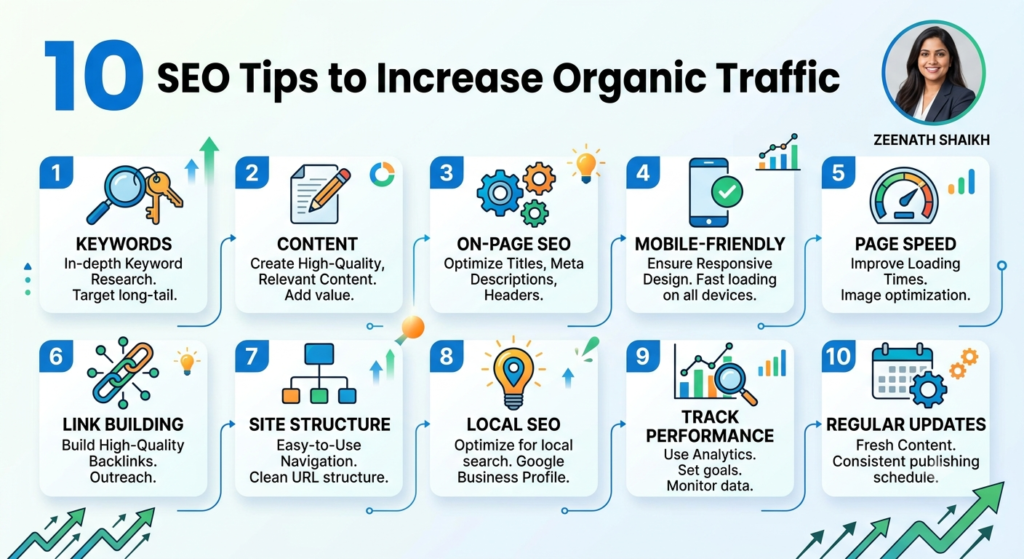
10 SEO Tips to Increase Organic Traffic.
Organic traffic is one of the most valuable sources of website visitors for any business. 10 practical SEO tips to increase organic traffic Unlike paid advertising, SEO can continue bringing relevant visitors to your website over time when your pages are properly optimized.
However, getting organic traffic is not simply about adding keywords to a website. Search engines consider many factors, including content quality, search intent, website experience, technical performance, backlinks, and relevance.
If you want your website to attract more visitors from Google and other search engines, you need a clear and consistent SEO strategy.
In this guide, we will explore 10 practical SEO tips to increase organic traffic and improve your website’s visibility in search results.
1. Focus on the Right Keywords
Keyword research is the foundation of SEO. Before creating a blog post or service page, understand what your potential customers are searching for.
Instead of targeting only highly competitive keywords, look for a combination of:
- Primary keywords
- Long-tail keywords
- Local keywords
- Question-based keywords
- Commercial-intent keywords
For example, instead of targeting only “digital marketing,” a freelancer in Mumbai could target phrases such as “digital marketing freelancer in Mumbai” or “SEO services for small businesses in Mumbai.”
The goal is not to use as many keywords as possible. The goal is to target keywords that match your audience’s needs and search intent.
2. Create High-Quality, Helpful Content
One of the most effective ways to increase organic traffic is to consistently publish useful content.
Your content should answer the questions your target audience is actually asking. Avoid writing articles simply to increase the number of pages on your website.
A good SEO article should provide:
- Useful information
- Clear explanations
- Practical examples
- Original insights
- Easy-to-read formatting
- Answers to common questions
Think about the problem your reader has and make your content the solution.
For example, instead of writing a generic article about SEO, you could create content such as “How to Improve Local SEO for a Small Business” or “SEO Tips for New Websites.”
Helpful content has a better chance of attracting visitors, earning links, and building trust.
3. Optimize Your Page Titles and Meta Descriptions
Your title and meta description are important because they help users understand what your page is about before they click.
A strong SEO title should be:
- Relevant to the target keyword
- Clear and specific
- Interesting to the reader
- Naturally written
For example:
Weak title:
SEO Tips
Better title:
10 SEO Tips to Increase Organic Traffic and Improve Google Rankings
Your meta description should briefly explain what the page offers and encourage users to click.
Remember that SEO titles should be written for humans first, not just search engines.
4. Improve Your Website’s Internal Linking
Internal links connect one page of your website to another. They help users discover more relevant content and help search engines understand the structure and relationships between your pages.
For example, if you publish a blog about SEO keyword research, you can link it to related pages about:
- SEO services
- Local SEO
- Google Business Profile
- Content marketing
- Website optimization
Use descriptive anchor text instead of generic phrases such as “click here.”
A well-planned internal linking structure can improve navigation, distribute page authority, and help important pages become easier for search engines to discover.
5. Optimize Your Website for Mobile Devices
A large number of users access websites through smartphones. If your website is difficult to use on a mobile device, visitors may leave quickly.
Make sure your website:
- Works properly on smartphones and tablets
- Uses readable text
- Has easy-to-click buttons
- Loads important content correctly
- Avoids unnecessary pop-ups
- Provides simple navigation
Mobile optimization is not only about appearance. It is also about creating a smooth user experience.
Before publishing a page, test it on different screen sizes and make sure visitors can easily read and interact with your content.
6. Improve Website Speed and Core Web Vitals
Website performance matters for both users and search visibility.
A slow website can create a poor user experience, especially for visitors using mobile networks. Large images, unnecessary plugins, excessive scripts, and poor hosting can all contribute to slower loading times.
To improve performance:
- Compress large images
- Use modern image formats where appropriate
- Remove unnecessary plugins and scripts
- Use browser caching
- Choose reliable hosting
- Optimize CSS and JavaScript
- Monitor Core Web Vitals
A faster website makes it easier for visitors to browse your pages and interact with your content.
7. Optimize for Local SEO
If you operate a local business, local SEO can be one of the best ways to attract highly relevant traffic.
Start by optimizing your Google Business Profile with accurate information, including:
- Business name
- Address
- Phone number
- Website
- Business category
- Opening hours
- Photos
- Services
You should also create location-relevant website content naturally.
For example, a digital marketing freelancer serving Mumbai could create useful content around topics such as SEO services in Mumbai, Google Ads for Mumbai businesses, or digital marketing strategies for local businesses.
Avoid creating low-quality location pages simply by changing the city name. Each local page should provide genuinely useful information.
8. Build High-Quality Backlinks
Backlinks are links from other websites pointing to your website. Quality backlinks can help establish authority and credibility.
However, getting hundreds of low-quality links is not a good SEO strategy.
Focus on earning relevant links through:
- Guest contributions
- Industry publications
- Business directories
- Local business websites
- Digital PR
- Original research
- Useful resources and guides
For example, if you publish an original industry report or a genuinely useful SEO resource, other websites may naturally reference it.
Quality and relevance are more important than simply counting backlinks.
9. Update and Improve Existing Content
SEO does not end when you publish an article.
Over time, information can become outdated, search trends can change, and competitors may publish better resources.
Regularly review your important pages and ask:
- Is the information still accurate?
- Are the keywords still relevant?
- Can the introduction be improved?
- Are there missing questions users may have?
- Are internal links available?
- Are there outdated statistics or examples?
- Can the content be made clearer?
Updating existing high-potential content can be more effective than constantly creating new articles.
Look at your Google Search Console data to identify pages that already receive impressions but have opportunities to improve their rankings and click-through rates.
10. Track Your SEO Performance
You cannot improve what you do not measure.
Use tools such as Google Search Console and Google Analytics to understand how your website is performing.
Monitor metrics such as:
- Organic clicks
- Search impressions
- Average position
- Click-through rate
- Organic users
- Top-performing pages
- Search queries
- Conversions
SEO usually takes time. Instead of expecting immediate results, track progress over several weeks and months.
If a page is receiving impressions but few clicks, you may need to improve its title and meta description. If a page receives traffic but does not generate enquiries, review the content, offer, and call-to-action.
How Long Does It Take to Increase Organic Traffic?
SEO is a long-term marketing strategy. Results depend on factors such as your website’s current authority, competition, content quality, technical SEO, backlinks, industry, and search intent.
Some improvements may produce results relatively quickly, while competitive keywords can take much longer.
The best approach is to focus on consistent improvement rather than expecting overnight rankings.
Create useful content, optimize your website, monitor performance, and continue improving pages based on real search data.
Common SEO Mistakes to Avoid
While implementing SEO, avoid practices that can damage your website’s performance or create a poor user experience.
Common mistakes include:
- Keyword stuffing
- Copying content from other websites
- Publishing thin content
- Buying low-quality backlinks
- Ignoring technical SEO
- Creating duplicate pages
- Using misleading titles
- Ignoring mobile users
- Publishing content without understanding search intent
- Never updating old content
SEO should be focused on providing genuine value to users.
Final Thoughts
Increasing organic traffic requires more than simply adding keywords to your website. A successful SEO strategy combines keyword research, helpful content, technical optimization, internal linking, local SEO, backlinks, mobile optimization, and continuous performance tracking.
Start with the basics and improve your website step by step. Focus on creating content that genuinely helps your audience and answers their search queries better than competing pages.
With consistent SEO efforts, your website can build greater visibility, attract relevant visitors, generate leads, and support long-term business growth.
Author: Zeenath Shaikh
Digital Marketing Freelancer specializing in SEO, Google Ads, Meta Ads, Social Media Marketing, Lead Generation, and Web Design.